This issue: 9 new finds across 9 devices in the dspm ecosystem, including 1 new connection idea.
New connections
Octatrack -> phone surface, both ways: AUDIO CC OUT through the CME host into octatrack-midi-control
Turn on the OT's stock AUDIO CC OUT, route its MIDI out back through the CME USB host into the octatrack-midi-control bridge, and have the bridge broadcast incoming CC 16-56 so phone faders follow the real knobs. No custom firmware.
Octatrack
Elektron Outbox 8: eight DC-coupled audio/CV outs over one USB cable, with a 24 PPQN clock gotcha
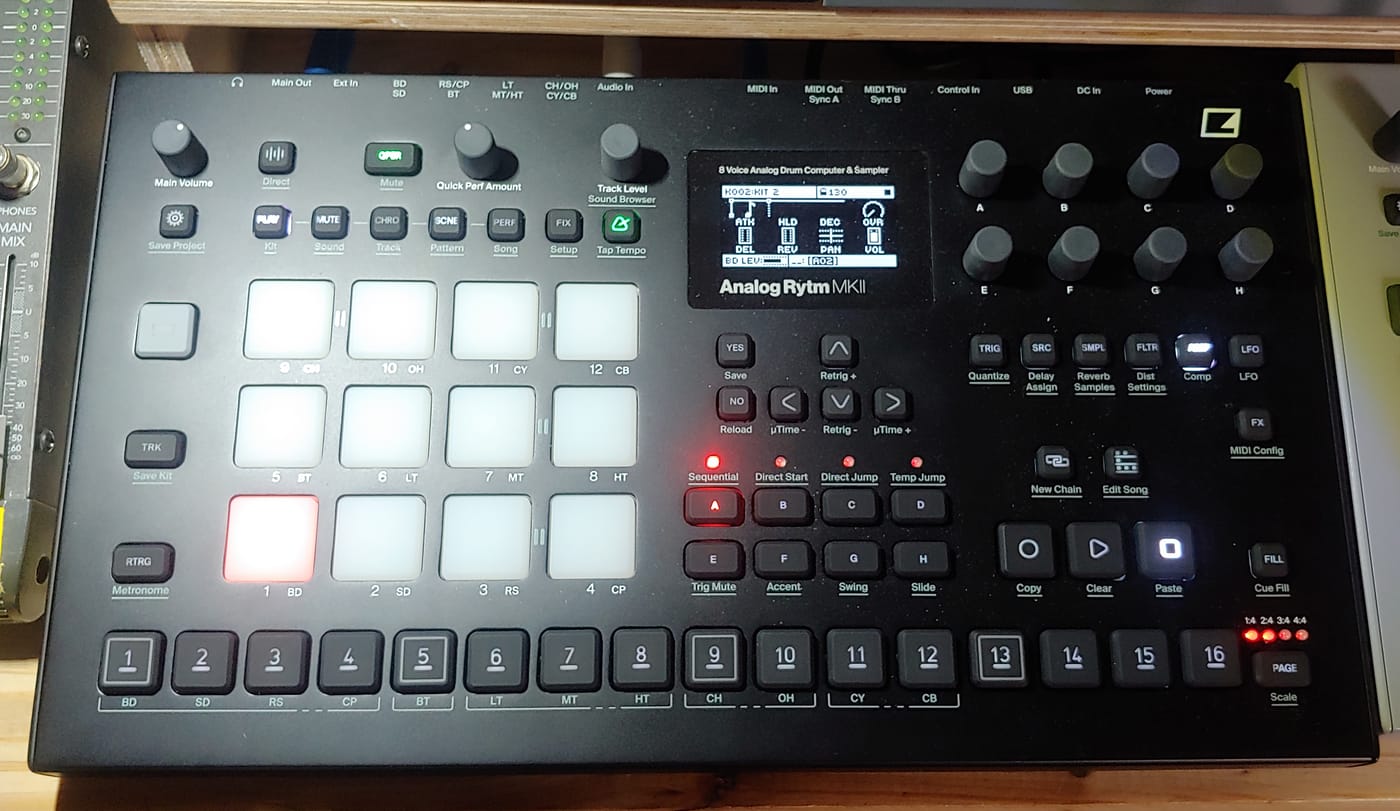
USB dual-role box: 8 balanced DC-coupled outs as audio or +/-5V CV (V/oct, gate, trig, clock) from Elektron boxes or any class-compliant host; Rytm multi-out lands in MKII OS only so far, OT gets CV but no multi-out.
Source: elektron.se
Octabam: an open-source OS remixer for the Octatrack adds CC feedback, USB-MIDI and MIDI scene locks
Community toolchain that builds a modded OT OS 1.40C image from your own copy: CC FEEDBACK (knobs send their CCs), CC MAP 62-73 for FX page 2, MIDI SCENES locks, USB-MIDI on the OT's own port. Unofficial, MKI+MKII, Elektron has banned it from Elektronauts.
Our octatrack-midi-control surface (PWA → WS bridge → MIDI, midi-map.js) is one-way today: the phone sends CC 16–56 and 112–127, but if someone turns a knob on the OT the phone fader goes stale. Note that the stock OS already sends audio-track knob moves as CCs when PROJECT > MIDI > CONTROL > AUDIO CC OUT is set to EXT or INT+EXT, so a two-way surface doesn't need Octabam (see this issue's connection article). What CC FEEDBACK may add is coverage the stock output lacks; check exactly which changes it sends that stock doesn't before treating it as a reason to flash. The new CCs (62–73, 80) don't collide with anything in our map, so they'd slot in as an extra "FX page 2" group.
Source: github
TouchDesigner
TouchDesigner 2025.33230: 1 kHz MIDI In CHOP, 14-bit CC as one event, OSC Out grouped by address
Sept 2026 official build: MIDI In CHOP samples at 1000/s (sub-frame timing), MIDI In DAT merges 14-bit MSB/LSB, OSC Out CHOP 'Transpose By Name' groups /path channels, new Time Filter POP smooths jittery data.
Source: derivative.ca release notes
TouchDesigner now timestamps MIDI at 1 kHz and reads 14-bit CCs natively
Builds 2025.32460-2025.33230 (Mar-Sep 2026): MIDI In CHOP Mode/Resample Mode capture events faster than the frame rate at 1000 samples/s with OS timestamps, Note-On Only Channels, 14-bit controller format, and OSC Out 'Transpose By Name'.
reactive-visuals reads the Rytm and the bridge over MIDI and OSC. At 60 fps TouchDesigner used to see at most one value per frame, so a Rytm hi-hat roll or ratchet collapsed into one flash. With 1 kHz timestamped MIDI every hit can be its own visual event, lined up to the millisecond with the drum instead of the frame. Rytm pads behave like note-on triggers, so "Note-On Only Channels" removes a class of stuck-note glitches.
Source: derivative.ca
Nord Micro Modular
Animatek G1-Emu: the Nord Modular G1 OS running in software, patched from a browser editor
Free early-alpha emulator (Sept 2026) that boots the real G1 Rack OS 3.03 on the Gearmulator framework; patches load from Animatek NME, NMEdit or nordmodulareditor.com. G1 only - no Micro Modular support claimed.
Our Nord is a Micro Modular, so this isn't a drop-in. The useful bit is indirect: the G1 and Micro Modular share a patch language and editor family. A G1 in software means sketching and testing patches at the laptop (no hardware, no MIDI cable) and moving the ones that only use modules the Micro has onto the real box. For the "Nord as an effect in the chain" angle, it's a cheap way to prototype a vocoder/filterbank patch first.
Source: synthanatomy
Pure Data
Pure Data 0.57: dynamic [clone], variable [receive], and [snake~] multichannel cables
Pd 0.57-0 (Oct 2026): [clone] allocates voices at runtime, [receive] takes a variable name, [snake~] pick/split/sum for multichannel, [oscparse] reads doubles, MIDI device rescan without restart.
Source: CDM (Peter Kirn)
Pure Data 0.57 test builds: snake~ multichannel tools, double-precision oscparse, MIDI rescan
Pd 0.57 (test builds, Oct 2026) adds [snake~ pick/split/sum] and [siginfo~] for multichannel signals, double type in [oscparse], a MIDI device rescan button, and dynamic [clone] allocation.
Two places this lands:
Source: cdm.link
RaspiAudio Pi5
CamillaDSP 4.0: native PipeWire backend, mixer matrix, and websocket filter read/write
v4.0 (Mar 2026, 4.1 since): PipeWire backend, a mixer matrix for N-to-M routing, filter parameter read/write and JSON config validation over the websocket API; MPL-2.0 added as a licence option.
Source: GitHub (HEnquist/camilladsp)
Auto-compiled by the dspm gear feed — an offline research archive of the gear behind the dspm performance ecosystem.